MRD — Minimum Required Dataset
Core cohort, baseline, aneurysm-treatment, DC and outcome information. Centres contribute consecutive adult aSAH cohorts—not selected DC cases.
International multicentre retrospective patient-level cohort study
DECIDE-SAHDEcompressive Craniectomy In SAH: an International Data-Driven Evaluation
DECIDE-SAH studies decompressive craniectomy as a timing-, indication-, severity- and technique-dependent treatment strategy. International centres contribute consecutive historical aSAH cohorts from pre-existing routine-care data.
Retrospective · Observational · Non-interventional · Secondary use of routine-care data
ClinicalTrials.gov · NCT07872774
Participation framework
The Minimum Required Dataset (MRD) is the participation threshold. Standard variables should be completed as fully as reliable source data permit; missing individual Standard variables do not by themselves exclude a centre. Optional extensions enable deeper phenotyping. Analysis eligibility is endpoint-specific.
Core cohort, baseline, aneurysm-treatment, DC and outcome information. Centres contribute consecutive adult aSAH cohorts—not selected DC cases.
Adds detailed timing, disease severity, haemorrhage and aneurysm characteristics, treatment course and follow-up outcomes where reliably available.
Deep phenotyping modules cover radiology, ICP, infarction/DCI, DC technique and complications, systemic complications and chronic hydrocephalus.
Scientific rationale
Existing evidence is predominantly observational and is affected by confounding by indication, treatment timing, baseline severity, technical heterogeneity and centre-specific practice. DECIDE-SAH therefore evaluates DC in the clinical context in which the decision is made.
The primary objective is to evaluate the association between DC strategy and unfavourable functional outcome at approximately six months, with particular focus on timing, neurological status at the treatment decision, indication and technical characteristics of decompression.
Ictus-to-decompression timing; early or pre-emptive versus delayed or rescue strategies.
Baseline and decision-time neurological status, including severity and herniation signs.
Documented indications: intracerebral haemorrhage, diffuse cerebral oedema, refractory intracranial hypertension, infarction with oedema and other recorded reasons.
Type and extent of decompression, technical strategy, redo DC and DC-related complications.
Study registration & ethics
Registered international non-interventional retrospective research coordinated by University Hospital Essen.
International network
The map shows outreach and replies during network development—not activated study sites. Practice variation is scientifically valuable: centres with high, low or even no DC volume can contribute if they provide consecutive aSAH cohorts.
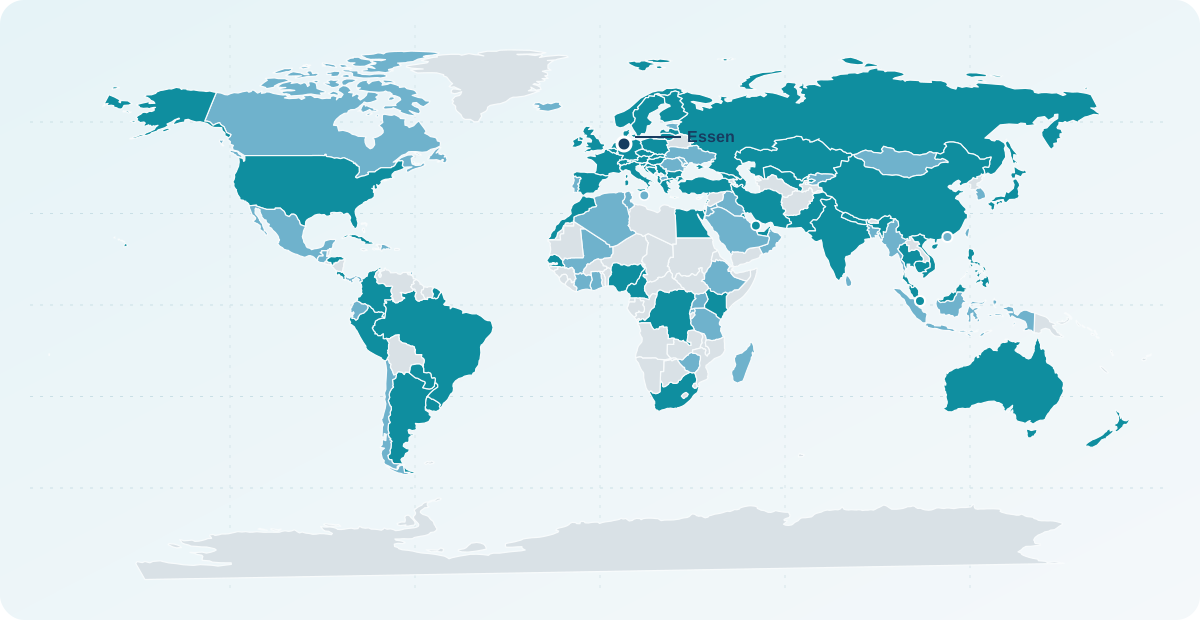
Contacted by the DECIDE-SAH team
Documented replies received
Network outreach snapshot: 22 October 2026. Replies are a subset of contacted centres; neither a reply nor an expression of interest constitutes formal site activation.
For interested centres
The key requirement is a reliable consecutive adult aSAH cohort and the MRD. Centres may contribute their largest reliably available historical cohort; additional Standard variables and extension modules are added according to local availability.
Express interest ↗Study documents
Concise reference materials for understanding the study and exploring scientific collaboration. Detailed data-collection materials are provided through direct coordination.
Contact
Interested in contributing a consecutive aSAH cohort or discussing feasibility? Contact the coordinating team in Essen. An expression of interest is non-binding; please do not send patient-level data or identifiers by email or through this form.
info@decide-sah.comProf. Dr. med. Ramazan Jabbarli
Coordinating Investigator · Department of Neurosurgery and Spine Surgery, University Hospital Essen, Germany.